
Dissidents
Is the leftist Tea Party already in full swing?


Progressive politics are at as low an ebb as they’ve been in a generation. That, at least, is the opinion of the beltway commentariat, fixated on the Democratic Party lacking any immediate power in Washington. That rude fact has engendered fatalism, best exemplified by an op-ed written back in February by James Carville, loudmouth relic of the Pax Clintonia. “With no clear leader to voice our opposition and no control in any branch of government, it’s time for Democrats to embark on the most daring political maneuver in the history of our party,” Carville wrote. “Roll over and play dead.”
Rather than ignore a strategist whose twisted sense of pragmatism helped set the stage for Trumpism by encouraging the Democratic embrace of Wall Street and globalist trade policy, the party has spent the ensuing months mostly following Carville’s lead in simply waiting for the president to screw the country up so badly that voters will have no choice but to vote blue during next year’s midterms. Take Hakeem Jeffries, who asked reporters earlier this year, “What leverage do we have? They control the House, the Senate, and the Presidency. It’s their government.”
It takes a short memory for a politician like Jeffries to talk himself into the position that influencing Washington is only possible if you control Congress or the White House. In the aftermath of the 2008 election, facing far more daunting legislative calculus than Democrats do now, Republicans almost immediately rallied in opposition to President Obama’s efforts to reform the healthcare system. Within a year of their landslide defeat, Republicans like Jim DeMint, Mike Pence, and Marsha Blackburn weren’t cowering. They were joining the Tea Party’s “Taxpayer March on Washington.”
Though the Tea Party was orchestrated by the Koch family and other conservative donors, congressional Republicans recognized that the sense of grassroots outrage at Democratic overreach embodied by the movement could be leveraged to affect the negotiations over Obama’s signature healthcare legislation.
They were right: that December, Democrats dropped the creation of a government-sponsored insurance plan (the so-called public option) from the bill, a consequential concession forced solely through public pressure — at the time, Democrats controlled 60 seats in the Senate, meaning they didn’t need a single Republican vote to get their way. Not only did the conservative strategy of vociferous protest manage to kill the public option, it set the stage for the 2010 election where they recaptured Congress in what Obama famously described as a “shellacking.”
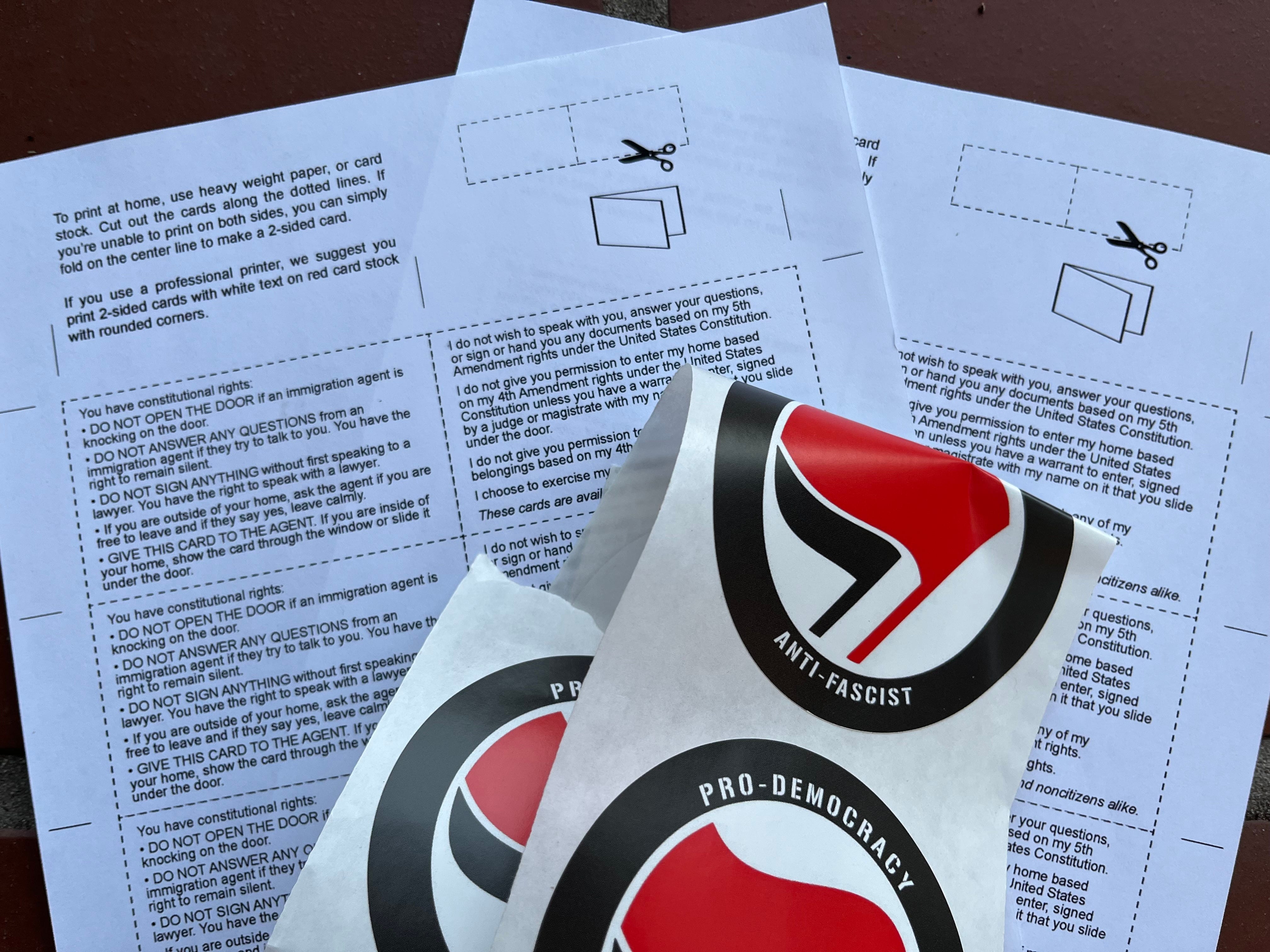
Today, the problem is not a lack of grassroots agitation against the Trump regime, but rather the apparent unwillingness of elected Democrats to actively engage it. This is most clearly seen in the disconnect between the DNC and the local organizers working to counter the administration’s deportation campaign. ICE Watch groups have popped up practically everywhere immigrants live. That includes Western Kansas, where residents of the three majority-minority counties in the region (which has a high proportion of immigrant laborers because of the meat packing plants located there) have been distributing Red Cards from the Immigrant Legal Resource Center at sympathetic businesses and sharing information about ICE raids on text chains. Similar efforts are happening in Alabama, Idaho, Arkansas — no matter how conservative a state’s politics, there’s a community of people there outraged by the administration and actively working to gum up the works of its deportation machine.
Even as some polls show 60 percent of Americans disagree with the administration’s draconian approach to immigration enforcement, national Democrats have struggled to harness that energy. Part of that gap has to do with the party’s persistent inability to come up with a coherent message: it is one thing to criticize the administration’s overreach and quite another to make a forceful argument that undocumented immigrants and refugees have a right to remain in the country that has become their home.
Imagine Chuck Schumer or Hakeem Jeffries participating in last month’s New Yorkers Against ICE Rally outside the agency’s office in Lower Manhattan. What would the minority leaders say when asked if they agree with the chants of protestors that no human being is illegal? That ICE should be abolished?
Six years ago, this was an actual policy debate. Alexandria Ocasio-Cortez called to shut down ICE during her insurgent primary campaign to unseat Joe Crowley in 2018; soon afterward, Congressman Mark Pocan introduced a bill that would do just that. Numerous Democrats endorsed abolishing ICE, even as Pocan’s bill faced no chance of reaching the House floor. The ability of Democrats at the time to actually eliminate a federal agency wasn’t the point: instead, the slogan “Abolish ICE” became a simple way to capture the idea that the American people broadly disagreed with the president’s immigration agenda. And it had an effect, with the outcry against ICE in the summer of 2018 helping to end the first Trump Administration’s family separation policy.
It’s strange, then, that even though Trump is back in power and his anti-immigrant campaign is more destructive than ever, nary a Democrat has dared utter the phrase “Abolish ICE.” No matter how critical they’ve been of the agency — most memorably, Tim Walz called ICE “Donald Trump’s modern-day gestapo” — Democrats have stopped short of renewing calls for restructuring of the agency, let alone wholesale elimination. After co-sponsoring Mark Pocan’s bill to do away with ICE six years ago, now Pramila Jayapal has introduced “The Stop ICE from Kidnapping US Citizens Act,” which would merely assert that ICE cannot detain American citizens, something that is already illegal.
Despite daily reports of ICE abusing its authority by shoving migrants into unmarked vans or detaining Army veterans for days on end, elected Democrats are proceeding as if the worst thing that could happen were for them to be perceived as “soft on immigration” — whatever that could possibly mean in the context of the Trump putsch. Perhaps if they had the guts to revive the Abolish ICE movement, they might have a hope of garnering the support of the tens of thousands of activists who are working so hard to protect their neighbors.
If not, so be it. The movement continues. Watching Paul Thomas Anderson’s One Battle After Another over the weekend, I couldn’t help but feel inspired by its narrative of broad-based, covert organizing against an ICE-like federal police force, including everyone from skateboarding punks to Black Power nuns. John Semley was correct when he wrote in his review of the film for the Nation that this is “a vision of cohesive American revolutionary left that may only actually exist in the paranoid Republican mind,” but we have to start somewhere, right?
I’ll take it as a small sign of hope that Chuck Schumer, at least, seems to have learned his lesson. After spending the summer vaguely hoping someone else — the courts, investors — might intervene to stop Trump’s wholesale makeover of the state, the Minority Leader finally appears willing to wrest a few concessions from the administration to prevent the looming shut down of the government. Hear Hear.
Meanwhile, the powers available to ordinary people at this moment are limited, but they are real. Distributing Red Cards, flyering for an ICE Watch training, or showing up at a No Kings rally, it sure beats crossing your fingers and hoping things don’t get too bad before the next election.

I’ll be in Los Angeles next week for the conference of the Urban History Association, where I’ll be joining a dream team of Angelinos for a discussion about the legacy of Mike Davis. Hard to overstate how much City of Quartz influenced my approach to storytelling and journalism, so I’m really excited to share some reflections on how his work helped me find a path into the urban histories of the Southwest that make up American Oasis.
Two recent stories to share. First, I had the honor of reviewing the late Richard Parker’s history of El Paso, The Crossing, for The Nation. Parker was a proud son of the borderlands and this book is a fitting tribute to his legacy given the profound argument it makes that embracing America’s multiculturalism is the only way to rebuild our civic fabric. Elsewhere, this month’s issue of Boston include my report on the just-opened South Station Tower. It’s an impressive addition to the skyline, albeit one that I fear only adds to the massive divide between those who can afford a perch in the sky and all the people struggling to get by in the buildings that fill their view.
Lastly, a quick plug to sign up for the Components newsletter — we’ll be relaunching the site very soon, so be sure to sign up so that the data research projects we’ve been working on for the past few months will get dropped directly in your inbox.
That’s all for now. Thanks, as always, for reading, subscribing, and buying American Oasis. You can find me on my website, or breathing a sigh of relief at a blast of cool sea air on an overcast day. Who knew it was possible to look forward to the winter?
Your pal,
Kyle