
Streamlining
Whose environment is it, anyway?
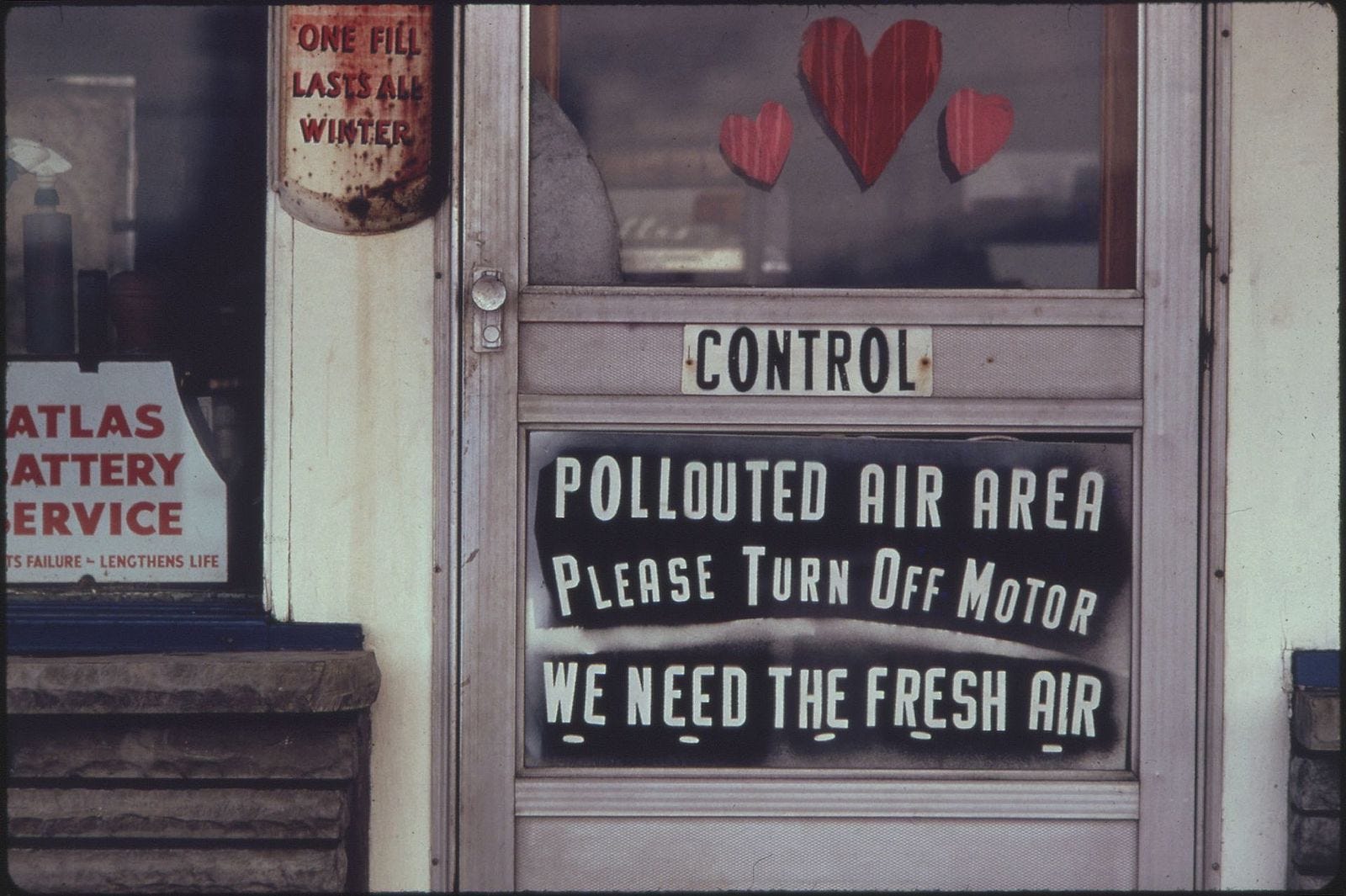
Yesterday, the Environmental Protection Agency announced its intention to cease protecting the environment in any meaningful way by rescinding its 2009 finding that greenhouse gas emissions threaten public health. “The proposal would, if finalized, amount to the largest deregulatory action in the history of the United States,” said Administrator Lee Zeldin. Indeed, absent the EPA’s “endangerment finding” on greenhouse gases, the agency would no longer be able to regulate carbon emissions from vehicles, power plants, or industrial facilities.
Meanwhile, the Department of the Interior has adopted “emergency permitting procedures” meant to shrink the most stringent review process under the National Environmental Policy Act for energy infrastructure development on federal land from an average of 2.8 years to just 28 days. In a statement, Interior Secretary Doug Burgum said, “We are cutting through unnecessary delays to fast-track the development of American energy and critical minerals.” In the first test of the new policy, the Bureau of Land Management rubber-stamped the environmental assessment for a proposed uranium mine in Utah in just 11 days.
At the same time the Trump Administration is waging war on all manner of environmental regulation, Democrats in California have been busy trimming the sails of the California Environmental Quality Act, its version of NEPA. Last month, Governor Gavin Newsom signed into law a suite of exceptions to CEQA meant to make it easier to build everything from apartment buildings to high-tech manufacturing facilities. One of the authors of the plan was San Francisco State Senator Scott Wiener, who answered the outcry from environmentalists across the state be telling CalMatters, “The environmental movement needs to ask itself: Why is it that CEQA keeps getting used to stymie climate action, whether it’s transit-oriented development or bike lanes or public transportation or phasing out oil?”
Over the past few years, the term “environmental” has become all but meaningless. While, at the turn of the 21st Century, anybody pushing to move the economy away from fossil fuels would undoubtedly be called an environmentalist, the growth of carbon-neutral energy infrastructure over the past decade has forced a schism in the movement. The rapid expansion of solar farms in the Mojave Desert means that local endangered species like the desert tortoise have lost tens of thousands of acres of habitat, while, last December, a uranium mine began operating on a National Monument near the Grand Canyon. The electric vehicle industry has propagated its own mining boom, with the $3 billion lithium mine in Nevada’s Thacker Pass proceeding toward construction and a cobalt mine opening in Idaho for the first time in decades.
Under no definition of environmentalism could any of these projects be considered beneficial to the specific ecology in which they operate, yet, with global temperatures rising, they all represent a small piece of the “green transition” that will theoretically allow the world to shrug off its carbon emissions without compromising economic growth. In practice, of course, that transition has thus far proved frustratingly slow: American carbon emissions have fallen in the past two decades, yet remain roughly where they were in 1990, while electric vehicle adoption has plateaued at about 8 percent of the market.
Perhaps it’s those lackluster numbers that are inspiring politicians like Wiener and Newsom to castigate environmental regulations as an enemy of climate progress. The goal of the reform effort in California — building more dense, infill housing — may indeed lead to fewer emissions in the future, but that doesn’t make the targeting of CEQA any less disconcerting than the Trump Administration’s efforts to circumvent the National Environmental Policy Act or eliminate the EPA’s ability to regulate carbon. “To meet California’s housing goals, we need certainty, accountability, and smarter land use — not the endless regulatory delays that have held us back for decades,” Gavin Newsom recently said, in a blue state echo of the rhetoric in Washington. “We’re done with barriers. Let’s get this built.”


.jpg)
The notion that merely loosening CEQA will open the floodgates of housing development in California seems far-fetched, especially given that the current housing shortfall is also attributable to high interest rates, inflated material costs, and a shortage of construction workers that only promises to get worse as Immigration and Customs Enforcement clamps down on the state. While CEQA has certainly been a powerful tool for obstructionist NIMBYs to slow high-density development in big cities, I fear that the desire to overcome such obstructionism will only lead to more sprawl.
In addition to simplifying the permitting process for apartment buildings, Newsom’s reform package includes the establishment of a statewide fund that suburban housing developers will be able to pay into in order to ignore limits on “Vehicle Miles Traveled,” a metric the state uses to estimate the emissions created by new projects that would place residents far from urban cores. A so-called VMT Mitigation Bank is already operational in San Bernardino County and has been contemplated elsewhere; now, the program is primed to go statewide, creating an efficient mechanism for cul-de-sacs to keep spreading outward regardless of their environmental impact. While the mitigation bank’s funds will support badly needed affordable housing projects in the state, it's impossible to argue that this provision will do anything other than facilitate the emissions-generating sprawl that the whole VMT system was created to stop in the first place.
Proponents would surely call such criticism nit-picking, just as they have dismissed fears that carving out a CEQA exception for high-tech manufacturing will undoubtedly make it easier for polluters to pollute. But let’s call it like it is. The rollback of CEQA, like efforts to marginalize NEPA, represent a broad-based, bipartisan effort to subordinate environmental regulation to economic development.
Nevertheless, the perception that Democrats are good stewards of the environment persists, if only because their efforts to undermine regulation are supposedly geared toward mitigating the climate crisis, not exacerbating it. In May, the Environmental Defense Fund announced that Gavin Newsom would co-chair its U.S. Climate Alliance, with the group’s state director crowing that the governor “has ensured the urgency and ambition behind California’s climate policies are based on the latest science.” Around and around we go, the climate fight increasingly masking the slow bleed out of the environmental movement into utter inconsequence.
It’s been a busy month for me at Columbia Journalism Review, given all the legal questions and controversy surrounding the merger of Paramount and Skydance. I wrote a piece about Paramount’s decision to pay Donald Trump $16 million to settle his frivolous lawsuit against 60 Minutes, as well as a longer report on the efforts of the Freedom of the Press Foundation to apply legal pressure on Paramount for that settlement through an unlikely mechanism of corporate law.
With new, horrifying images of starving children coming out of Gaza on a daily — if not hourly — basis, I’ve been trying to read more on-the-ground reporting about the situation from Palestinian writers unburdened by the Western media’s reflexive deference to an Israeli regime that seems hell-bent on sequestering Gazans into as small an area as possible in order to colonize what remains of the Strip in the same matter that they did the West Bank. We Are Not Numbers does a wonderful job of elevating those voices, and I was particularly moved by a recent piece by the writer and educator Samah Zahar Zaqout about how the past two years of war have built on the decades of oppression and violence that preceded them to leave so many Gazans feeling utterly lost. “I have been displaced 12 times since October 2023,” Zaquout writes. “Even the way we walk has changed; it has become slower and heavier. This ‘war’ has deprived us of our casual gaits, because even this has become too much to bear. Walking doesn’t bring us comfort anymore; it only deepens the pain. Every step reminds us of what we’ve lost.”
That’s all for now. Thanks, as always, for reading, subscribing, and buying American Oasis. You can find me on my website, or in the surf at Pacific Beach, eyes red from seawater as I try to pop up and stand on the waves for more than a second or two.
Your pal,
Kyle